
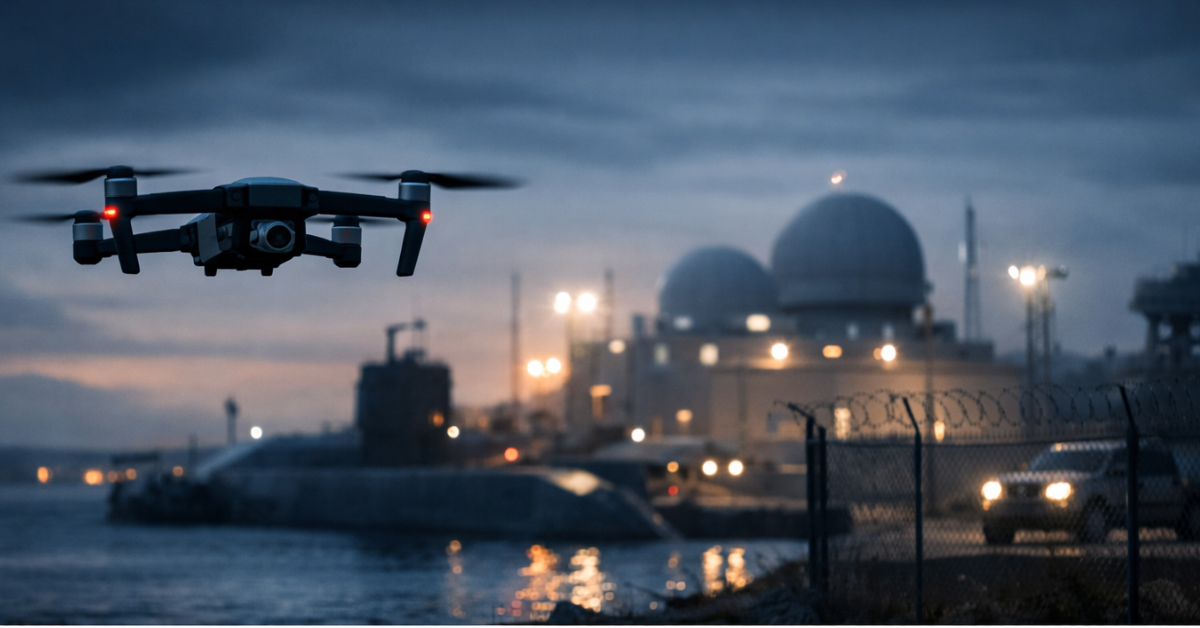
When drones appeared over France’s Île Longue nuclear submarine base, home to the country’s ballistic missile submarines, the event was one of a series of turning points in the history of warfare. French forces deployed electronic warfare systems, scrambled rapid-response teams, and even opened fire as the drones crossed into one of the most sensitive airspaces in Europe. It remains unclear how many, if any, were neutralized.
A NATO nuclear stronghold, designed to withstand nation-state threats, was forced into emergency response mode by devices that cost less than a flat screen TV. And this is only the beginning. Indeed, the traditional hierarchy of military power has flipped.
Yet this isn’t a story about France alone. It is a story about the unpreparedness of European forces writ large in light of the democratization of military technology.
The Tables are Turning
Small UAVs are already reshaping modern conflict.reshaping warfare. In Ukraine they account for a majority of Russia’s recorded battlefield casualties. Elsewhere, drones have closed down airports in both Copenhagen and Oslo. They’ve been spotted over nuclear power plants in Belgium as well as an airforce base in The Netherlands.
The defining qualities of this technology make it uniquely destabilizing. Intelligence operations once required satellites, spy planes, elite operatives, and nation-state budgets. Yet drones are inexpensive, easy to acquire, scalable, difficult to detect, and increasingly automated. They fly below radar, require no runway, and can be operated anonymously. This makes spycraft simple for the West’s adversaries, as European air defenses were built to intercept fast-moving, high flying aircraft, not slow, loitering quadcopters.
This mismatch between attacker and defender is creating a new era of strategic vulnerability. Western governments spend billions building and protecting critical infrastructure, but an adversary can bypass these defenses with technology that costs less than a home appliance. UAVs are creating a new power imbalance that rips apart the old playbook of deterrence, leaving defense forces worldwide scratching their heads and scrambling for solutions.
Looking Towards the Future
Western governments must overhaul their assumptions regarding air defense by adopting a layered counter-drone strategy that relies on affordable, scalable technologies. Many of the tools required to detect and defeat small UAVs, including AI enabled optical sensors, compact jammers, and low-cost kinetic interceptors, are inexpensive enough to deploy widely across strategic and civilian sites. Policymakers should prioritize a distributed, integrated approach that pairs early detection with rapid electronic or kinetic response, supported by procurement processes that match the speed of commercial drone innovation.
Western nations must accept that low-cost aerial technologies now carry strategic consequences and must respond accordingly. The sooner this reality is acknowledged, the stronger the foundation of future stability will be. Europe is now at a turning point as asymmetric warfare reaches deep into the alliance itself.
They must understand that the threat is no longer at their doorstep, it’s sitting in the kitchen.